

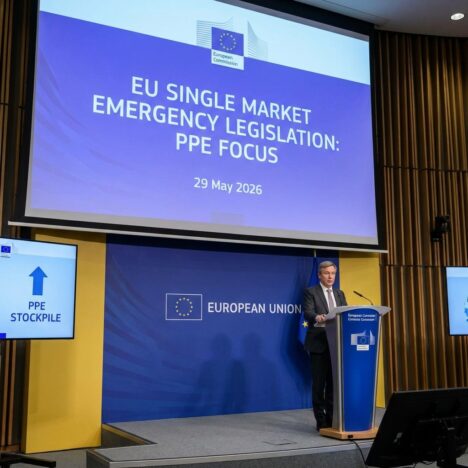
Regulation 2016/425, the European Union’s key regulation on Personal Protective Equipment (PPE), has undergone a comprehensive revision in line with lessons learned from the COVID-19 pandemic experience. New “emergency procedures” became applicable as of May 29, 2026.
From Pandemic Legacy to New Regulation
Severe disruptions in the supply of PPE such as masks, gloves and protective overalls during the COVID-19 pandemic showed that normal CE certification processes are inadequate in times of crisis. This experience led the EU to prepare a comprehensive legislative package to strengthen internal market resilience.
Important Dates
| History | Development |
| October 9, 2024 | Adopted by the European Parliament and the Council of the EU |
| November 8, 2024 | Published in the Official Journal of the EU (OJ L, 2024/2748) |
| April 22, 2025 | Corrigendum published |
| May 29, 2026 | Implemented in practice |
Legal Architecture with Two Statutes
The arrangement was set up with a twin statute structure:
- IMERA Regulation 2024/2747 (Internal Market Emergency and Resilience Act): Establishes the main framework, establishes a three-tier crisis management system (ordinary period / vigilance mode / emergency mode).
- Omnibus Regulation 2024/2748: Sets out how this framework will be reflected in 6 different product legislations, including PPE. Article 4 of 2024/2748 directly amends the PPE Regulation 2016/425.
Note: 2024/2748 does not change the existing articles of 2016/425 – it adds a new chapter regulating emergency procedures. Therefore, the consolidated text in EUR-Lex is not yet subject to change; it will be updated after 29 May 2026.
Content of the Amendment: What Happens in an Emergency?
When the “internal market emergency mode” is activated by the Council of the EU and certain PPE is placed on the list of “crisis-critical goods”, the following mechanisms come into play:
1. Priority Conformity Assessment: Notified bodies have to move crisis-critical PPE applications to the front of the queue. Processes that normally take months are reduced to weeks.
2. Fast-Track: For crisis-critical products, the Commission can apply an accelerated launch procedure and exemptions from product-specific rules.
3. Common Specifications: Compliance, normally based on harmonized standards such as EN 149 (masks) and EN 388 (gloves), will be ensured through “common specifications” to be issued directly by the Commission during the crisis.
4. Flexibility of the Presumption of Conformity: The Commission can lower the standard thresholds for the presumption of conformity and in some cases remove the requirement for notified bodies to be involved.
5. Flexibility in Market Surveillance: Member state authorities may allow PPE to be placed on the market during a crisis period even in the absence of complete documentation, subject to minimum safety criteria.
6. Priority Production Orders: The Commission can request “priority-rated requests” from manufacturers of critical PPE; companies must place these orders ahead of other commercial orders.
Important Notice: Not Automatic Enforcement
May 29, 2026 is the date when these mechanisms become available, not the automatic activation date. The rules only come into effect during a crisis period when the Council officially activates the “internal market emergency mode”. Normally, the CE process for PPE manufacturers continues exactly as under 2016/425.
Meaning for Turkey
As a member of the Customs Union, Turkey exports a significant amount of PPE to the EU market. A possible EU emergency mode would create both opportunities and obligations for Turkish manufacturers:
- Possibility to benefit from accelerated CE processes for products on the crisis-critical PPE list
- Authorization to conduct priority assessment for EU-recognized notified bodies such as TSE
- Obligation to respond to priority order requests from the Commission
Turkey’s national legislation (PPE Regulation published in the Official Gazette dated May 1, 2019 and numbered 30761) has not yet reflected this change. The Ministry of Trade is expected to initiate a parallel harmonization effort in the coming period.
Official Sources
- Official reference: OJ L, 2024/2748, 8.11.2024
- EUR LEX: http://data.europa.eu/eli/reg/2024/2748/oj
Related Posts
A New Era for PPE: The EU Has Updated Its Harmonized Standards
The European Union’s framework for the conformity assessment of personal protective equipment (PPE) is being…